
The Forgotten Children of the Parramatta Female Factory
For thousands of women transported to Australia, the sentence of transportation meant far more than imprisonment. It meant the loss of their homes, their husbands, their children and, sometimes, their families forever.
Behind the sandstone walls of the Parramatta Female Factory were women who had left children in Britain and Ireland, mothers who had endured the long voyage to Australia with infants in their arms, and women who gave birth while prisoners of the Crown.
Some would never see their children again.
Others watched helplessly as colonial authorities removed their children to orphan schools, often because their mothers were considered morally unsuitable or unable to provide for them.
Yet amid these stories of separation are also accounts of extraordinary determination, mothers petitioning the government, families reunited, and women rebuilding their lives against overwhelming odds.
The history of the Parramatta Female Factory is as much a history of mothers and children as it is a history of convict women.
Transportation — The First Separation
When a woman was sentenced to transportation, the punishment often extended far beyond the courtroom.
For a married woman with children, transportation could mean separation from her husband and older children for seven years, fourteen years or life. A sentence intended for one individual could effectively destroy an entire family.
Many women left their children in the care of relatives, neighbours or parish authorities, with little expectation of seeing them again.
Others were permitted to take young children aboard convict transports. The colony consequently received women accompanied by infants, toddlers and older children whose welfare became the responsibility of the colonial administration.
Historical estimates suggest approximately 2,000 children accompanied transported parents to Australia. Individual convict vessels sometimes carried substantial numbers of children in addition to their female prisoners.
The Elizabeth, arriving in 1828, transported 134 Irish convict women and 18 accompanying children, the eldest aged fourteen.
For these children, the voyage was not simply a journey to a new country. It could be the beginning of another separation — this time from the only parent they had known. [1, 2]
Susannah Watson — A Mother’s Lifelong Loss
Few stories illustrate the human cost of transportation more poignantly than that of Susannah Watson, whose life was reconstructed by historian Babette Smith in A Cargo of Women.
Susannah was transported from Nottingham aboard the Princess Royal, arriving in Sydney in 1829.
She had been convicted of theft at a time when her family was struggling with poverty. Four surviving older children were left behind in England, while her infant son Thomas accompanied her to Australia.
Susannah was subsequently sent to the Parramatta Female Factory, where she gave birth to another son, Charles, in July 1830.
Her young son Thomas was placed in an orphan institution, where he died in 1831.
Although Susannah eventually gained her freedom and established another life in New South Wales, she never saw her four children in England again.
She maintained contact through letters, some of which survived and were eventually preserved in the Mitchell Library.
Those letters reveal the complicated emotions of a woman who came to appreciate her new life in Australia while continuing to grieve for the children she had left behind.
Her descendants in Australia and England eventually rediscovered their shared family history through the research of Babette Smith, Susannah’s great-great-granddaughter.
Susannah’s story reminds us that freedom from a sentence did not necessarily mean freedom from loss. [3, 4]
Motherhood Inside the Female Factory
The Parramatta Female Factory was not simply a gaol or place of punishment.
It also functioned as a maternity hospital, refuge and institution for women who had nowhere else to go.
Many female convicts became pregnant while assigned as domestic servants or working in colonial households. Some had relationships with fellow convicts, soldiers, settlers or employers. Others found themselves pregnant without the financial or practical support of the child’s father.
Pregnant women could be returned to the Female Factory, where the Lying-in Hospital provided maternity care.
The sound of crying infants and young children would have been part of everyday life within the institution.
For some women, the Factory provided essential medical attention and temporary shelter. For others, it meant continued confinement and uncertainty about what would happen to their children.
The colony was reluctant to maintain women and their children indefinitely at public expense. Authorities sought to return women to assignment and place children in institutional care when they reached an age considered suitable for separation. [5, 6]
When Children Were Taken Away
One of the most distressing aspects of the female convict system was the separation of mothers from their young children.
Infants born within the Female Factory were generally permitted to remain with their mothers during their earliest years.
By approximately three or four years of age, however, children could be transferred to an orphan school. Some were separated earlier, depending on institutional conditions and administrative decisions.
The term orphan was misleading.
Many children admitted to these institutions had living mothers or fathers. Their parents might be imprisoned, serving a transportation sentence, working under assignment, impoverished or judged incapable of providing suitable care.
Colonial officials frequently believed that removing children from convict parents would protect them from poverty, immorality and the supposed influence of criminal behaviour.
These attitudes reflected the severe moral judgements imposed upon convict women.
A mother might love her child deeply yet still be considered unfit to raise that child because she was a prisoner, had no independent income or lacked a recognised family home.
The separation could be devastating. A child taken into institutional care might spend years apart from their mother and eventually be apprenticed to an employer.
For some families, the separation became permanent. [5, 7]
The Female Orphan School — Established 1801
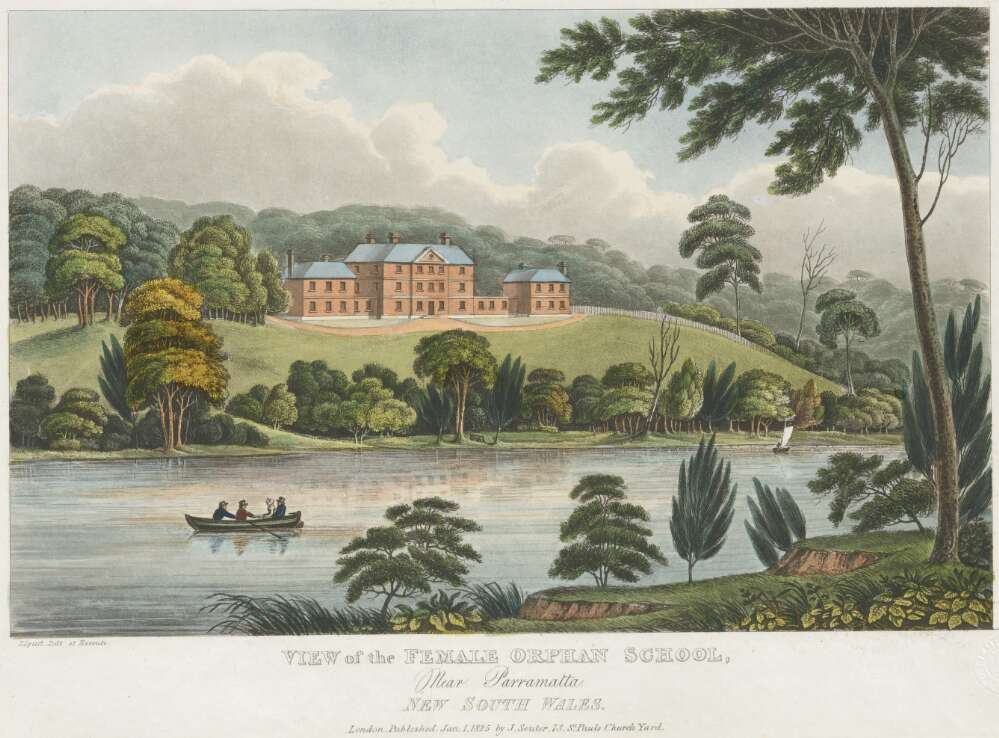
The first Female Orphan School opened in Sydney in 1801, under Governor Philip Gidley King, with the Reverend Samuel Marsden playing a significant role in its development.
In June 1818, the girls were moved to a substantial purpose-built institution at Rydalmere, overlooking the Parramatta River.
The magnificent three-storey building, later associated with Western Sydney University and the Whitlam Institute, survives today.
The school accommodated girls described as orphaned, abandoned or destitute, including daughters of convict women.
Its stated purpose was to provide religious instruction, basic education and domestic training while protecting girls from the supposedly corrupting influences of their parents and the wider colonial community.
Girls were taught reading, writing, sewing, laundry, housework and other domestic skills. As they grew older, many were apprenticed to households as servants.
Although the institution provided food, shelter and education, it also regulated children’s behaviour and prepared them for the colonial labour market.
For many convict mothers, the Female Orphan School represented the place where their daughters were growing up without them. [7, 8]
The Male Orphan School — Established 1819
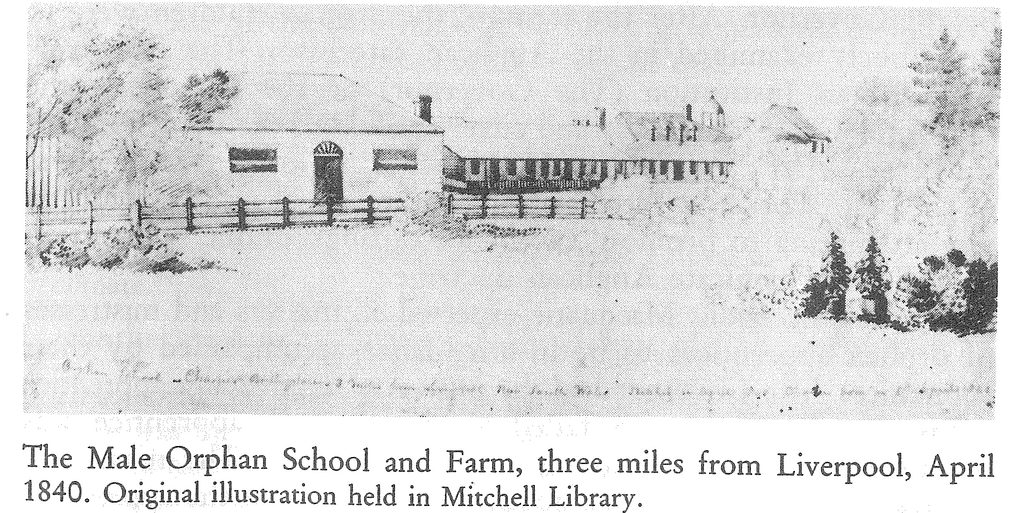
The Male Orphan School was established in Sydney in 1819, occupying the former premises of the Female Orphan School in George Street.
It received boys who were orphaned, destitute or whose parents were unable to care for them.
The institution moved to the Cabramatta district, now Bonnyrigg, during the 1820s.
Boys received basic education and practical instruction in agriculture and trades. As they became older, they could be apprenticed as farm workers, domestic servants, labourers or tradesmen.
Like the Female Orphan School, it served a dual purpose: providing care and producing trained workers for the growing colony.
Brothers and sisters could therefore find themselves separated not only from their mothers but also from each other, living in different institutions.
The Male Orphan School closed in 1850, when the boys joined the girls at Parramatta in the combined Protestant Orphan School. [9]
The Roman Catholic Orphan School — Established at Parramatta in 1844
The growing number of Irish Catholic families in New South Wales created demands for orphan institutions that would accommodate children within their own religious tradition.
A Roman Catholic Orphan School had been established in Sydney’s eastern suburbs during the 1830s.
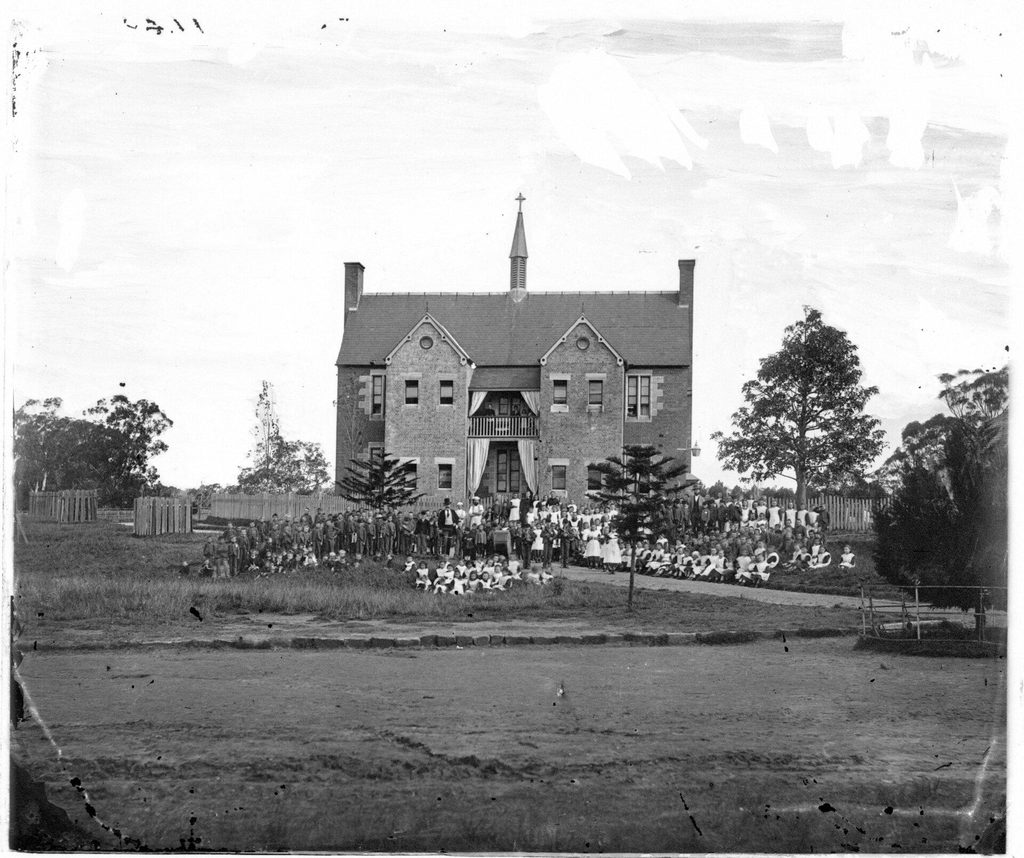
On 8 March 1844, a new purpose-built Roman Catholic Orphan School opened immediately beside the Parramatta Female Factory, at what is now 1 Fleet Street, North Parramatta.
The institution initially accommodated Catholic boys and girls aged approximately three to nine, although its admission arrangements later expanded.
Its residents included children whose parents had died, children from impoverished families and some who had been removed from mothers confined within the adjoining Female Factory.
This placed two institutions with closely connected histories beside one another: the Female Factory, housing convict women and mothers, and an orphan school accommodating children who might have living parents nearby.
The school offered education and religious instruction, but its children were also subject to institutional discipline and preparation for work.
In 1859, responsibility passed to the religious sisters later known as the Sisters of the Good Samaritan.
The orphan school operated until 1886, when the site became the Parramatta Industrial School for Girls — beginning another chapter in the precinct’s institutional history. [10, 11]
A Mother’s Petition — The Struggle to Recover a Child
Separation did not necessarily end when a woman left the Female Factory.
A mother seeking the return of her children generally had to petition the colonial authorities or the relevant orphan school administrators.
Such requests were made through formal applications and correspondence, often involving the Colonial Secretary, school committees or other government officials.
A mother could be required to demonstrate that she had the practical means to maintain her children, appropriate accommodation and circumstances considered suitable for their upbringing.
A marriage, stable employment or a husband with an established trade could strengthen an application.
But these were not guarantees. Officials retained the authority to approve or refuse requests.
The surviving petitions reveal women making determined efforts to restore family relationships despite their limited social status and legal rights.
The very act of asking permission to reclaim one’s children reminds us how much control the colonial government exercised over convict family life. [7, 12]
Elizabeth Browning Owen — A Family Reunited
Not all stories ended in permanent separation.
Elizabeth Browning Owen, transported aboard the Morley in 1820, arrived in New South Wales with her four children: John, Eliza, Robert and Elizabeth.
Her determination to keep the family together had begun before the ship left England. Her eldest child was initially considered too old to accompany her, but the ship’s surgeon intervened and permission was obtained for all four children to travel.
Following arrival, Elizabeth was sent to the Parramatta Female Factory. Her daughters, Eliza and Elizabeth, were admitted to the Female Orphan School.
Elizabeth subsequently married Emanuel Marvin at St John’s Church, Parramatta, on 11 March 1822.
She applied for the return of her daughters, but her request was refused.
In 1823, Emanuel Marvin submitted another application for the girls’ release, which was successful.
Elizabeth’s daughters were finally able to rejoin the family.
The family established a life in Parramatta, where Emanuel worked as a carpenter and later became associated with local hotels.
Elizabeth died in 1839 and was buried at St John’s Cemetery.
Her story represents an extraordinary act of maternal persistence — and a rare opportunity to see, through surviving documents, the successful reunion of a family divided by colonial institutions. [13]
New Families, Old Sorrows
For some convict women, transportation produced successive chapters of motherhood.
A woman might have left children behind in Britain or Ireland, given birth to another child in the colony and later established a new family following marriage or freedom.
In some cases, this amounted to three distinct family experiences, separated by oceans, institutions and changing relationships.
The encouragement of marriage within the convict system offered some women opportunities for stability and support, but it could not erase the experiences of earlier separation.
A mother might raise several Australian-born children while knowing that sons and daughters in Britain were growing into adulthood without her.
Other women attempted to recover their children from orphan schools, while some formed new families without being able to re-establish relationships with children from earlier periods of their lives.
We cannot assume that every separated family was reunited, nor that every separation was permanent. The surviving records are incomplete and the experiences varied enormously.
What is certain is that transportation profoundly reshaped family relationships across generations. [3, 12, 14]
The Children Also Had Stories
The children of the Female Factory were not merely dependants recorded alongside their mothers’ names.
They were individuals whose lives were shaped by events over which they had little control.
Some survived the voyage from Britain or Ireland, only to experience another separation in the colony.
Some grew up in orphan schools, learned trades or domestic work, and were placed in service while still young.
Others died in infancy, in the Female Factory hospital or in institutional care.
Many eventually established families and contributed to the development of colonial Australia.
Their experiences remind us that the consequences of transportation extended beyond the convict generation.
Behind every entry in an orphan school admission register, baptismal record or application for release was a child — and often a mother who wanted that child back.
Remembering Mothers and Children
Today, the surviving buildings of the Parramatta Female Factory, the Female Orphan School and the Roman Catholic Orphan School form an extraordinary historical record of the development of Australia’s early institutional welfare system.
They also preserve a more personal history of love, separation, loss, determination and reunion.
The stories of Susannah Watson and Elizabeth Browning Owen reveal different outcomes, yet both remind us that convict women were mothers who cared deeply about the futures of their children.
The history of the Parramatta Female Factory is not complete unless we remember the children — those who were left behind, those who were taken away and those who were finally reunited with their mothers.
Their stories are part of Australia’s living history.
Discover Your Family’s Story
Parramatta Female Factory Friends continues to research the lives of female convicts, their children and descendants.
If your ancestors were connected with the Parramatta Female Factory or the orphan schools, our Research Centre may be able to assist.
Family descendants are also encouraged to share photographs, letters and historical documents that help recover these often-forgotten lives.
Discover the Babette Smith Collection
History. HerStory. OurStory.
Many Stories. One Australia.
Australia’s Living Story on Dharug Country.
Historical Sources and Endnotes
- Libraries Tasmania, Before Transportation to Australia. Statistics concerning female convict transportation, children accompanying parents and family separation.
https://libraries.tas.gov.au/family-history/convicts-in-van-diemens-land-now-tasmania/before-transportation/ - Parramatta Heritage Centre and University of Western Sydney, Women Transported: Life in Australia’s Convict Female Factories (2008). Experiences of transported mothers and children, particularly the discussion of accompanying children and orphan schools.
https://historyandheritage.cityofparramatta.nsw.gov.au/sites/phh/files/field/media/file/2020-09/women-transported.pdf - Babette Smith, A Cargo of Women: Susannah Watson and the Convicts of the Princess Royal (1988; subsequent editions). A major biographical study of Susannah Watson and the transported women of the Princess Royal.
- Parramatta Female Factory Friends, Babette Smith Collection, including the story of Susannah Watson and her descendants.
https://www.parramattafemalefactoryfriends.com.au/research-centre/babette-smith-collection/ - Museums of History NSW, Female Factory, Parramatta. Records concerning maternity, children of convict women and orphan school transfers.
https://mhnsw.au/guides/female-factory-parramatta/ - City of Parramatta, Parramatta Female Factory Bicentenary 1821–2021. The Factory as a lying-in hospital, the role of midwives and experiences of pregnant convict women.
https://historyandheritage.cityofparramatta.nsw.gov.au/parramatta-female-factory-bicentenary-1821-2021 - Museums of History NSW, Child Care and Protection Guide. Orphan school admission, discharge, apprenticeship records and petitions for the return of children.
https://mhnsw.au/guides/child-care-and-protection-guide/ - Whitlam Institute, Western Sydney University, History of the Female Orphan School. Establishment, purpose, discipline and education of girls at Parramatta.
https://www.whitlam.org/history-of-the-female-orphan-school - State Library of NSW, Male Orphan School. Establishment, education, apprenticeships and institutional history.
https://www2.sl.nsw.gov.au/archive/discover_collections/history_nation/religion/charity/rollbook/Male_orphan_school.html - City of Parramatta, Parramatta Roman Catholic Orphan School Site. Development of the institution and its later uses.
https://historyandheritage.cityofparramatta.nsw.gov.au/blog/2015/08/13/parramatta-roman-catholic-orphan-school-site - City of Parramatta, 200th Anniversary of Catholic Education in Parramatta. Catholic orphan school admission policies, religious administration and institutional development.
https://historyandheritage.cityofparramatta.nsw.gov.au/research-topics/education/200th-anniversary-of-catholic-education-in-parramatta - Carol Liston, “Female Convicts and Their Children, NSW 1820–1840”, in Islands of History: Proceedings of the 25th Anniversary Conference, Professional Historians Association (NSW) (2010). Examines convict women’s negotiations with authorities, family relationships and remarriage.
https://researchers.westernsydney.edu.au/en/publications/female-convicts-and-their-children-nsw-1820-1840/ - Parramatta Female Factory Friends, Newsletter No. 8, April–May 2016, research by Beth Matthews: “Elizabeth Browning Owen”, including the applications made by Elizabeth and Emanuel Marvin for the return of her daughters.
https://www.parramattafemalefactoryfriends.com.au/wp-content/uploads/2021/11/PFFF-NEWSLETTER-08-APR-MAY-2016.pdf - Museums of History NSW, Families of Convicts. Colonial marriage, family reunification, applications and the conditions affecting convict family life.
https://mhnsw.au/guides/families-of-convicts/
Parramatta Female Factory Friends Inc.
Protecting the past. Researching the women. Sharing the stories.