
The first female factory in Australia opened in 1804 in rooms above the men’s gaol at Parramatta. From that early workshop grew a network of institutions across New South Wales and Van Diemen’s Land. The State Library of NSW identifies 13 factories, counting two premises each at Parramatta, Port Macquarie and Moreton Bay. George Town is counted as one institution even though it occupied more than one building. [1], [2], [3]
A female factory could be a workshop, a place of punishment, a depot for assigning women to employers, or a place where pregnant, nursing or unwell women were sent. Its role depended on where it stood and when a woman passed through it. PFFF’s historical fact sheet records 24,960 women transported to New South Wales and Van Diemen’s Land combined and estimates that about 5,000 passed through Parramatta Female Factory. The combined figure includes women who never entered a factory. [2], [4]
New South Wales and Moreton Bay
1. The Factory above the Gaol, Parramatta · 1804–1821
Governor Philip Gidley King had space added above the gaol at Parramatta for women awaiting assignment and women returned by employers. The factory put their labour to use in textile production. Work and accommodation competed for space in the cramped gaol premises. [2]
The upper-floor workshop established a system for supervising labour and holding women between assignments. The move in 1821 gave the administration a separate complex for those functions, with space for accommodation, workshops and medical care. When searching early records, remember that a reference to the Parramatta factory before 1821 points to the gaol premises. [2]
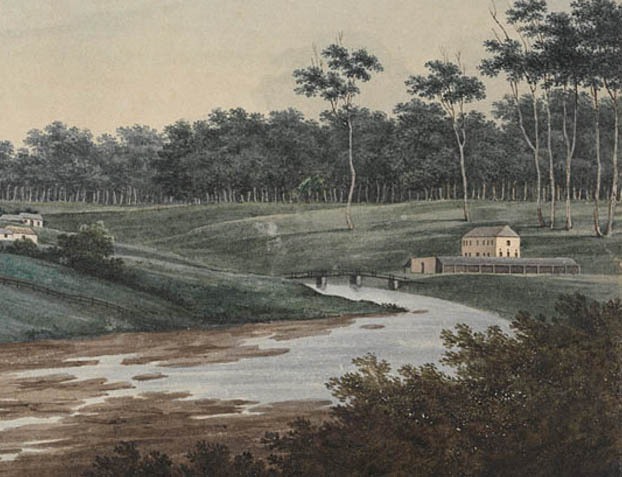
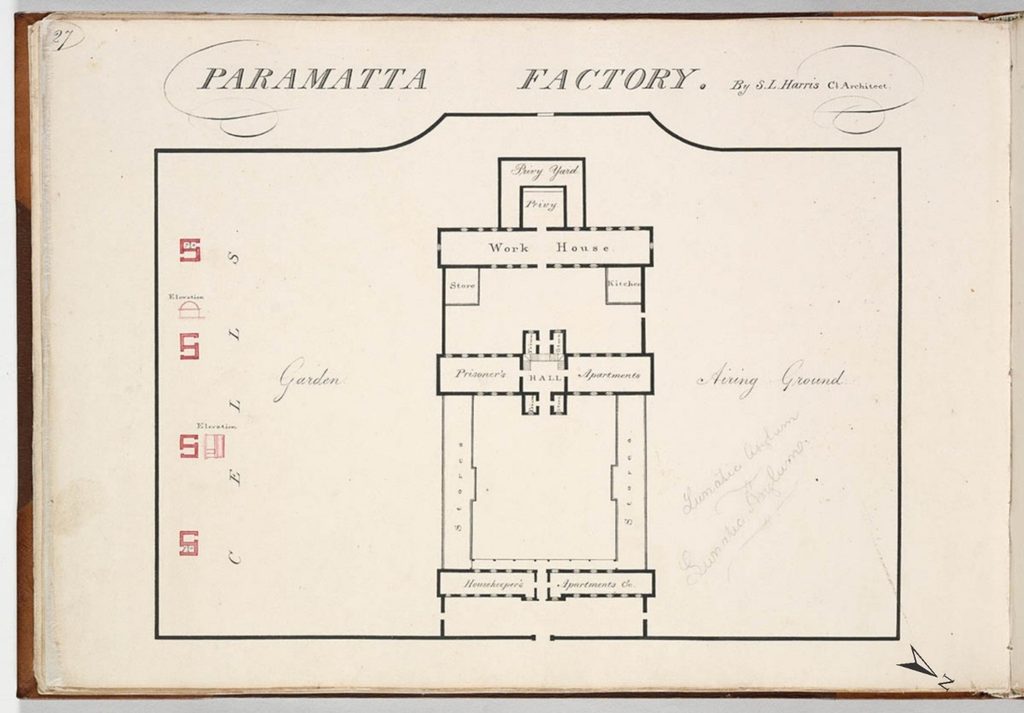
2. Parramatta Female Factory, North Parramatta · 1821–1848
The purpose-built factory opened in 1821 on the Parramatta River. Francis Greenway’s complex brought together the reception and assignment of women, textile manufacture, accommodation and medical care. Women spun and wove, sewed, washed clothes and worked in the hospital. Over time, a system of classes distinguished women awaiting assignment, those who needed care and those under punishment. [2]
The North Parramatta site preserves buildings and walls from the factory period, including the Matron’s and administration building, Lying-In Hospital and Third Class Penitentiary. For individual histories, start with the State Archives guide to the Parramatta Female Factory and its court-sentence index. The index covers a specific route into the factory. Assignment, medical and discharge records can add other parts of a woman’s story. [2]
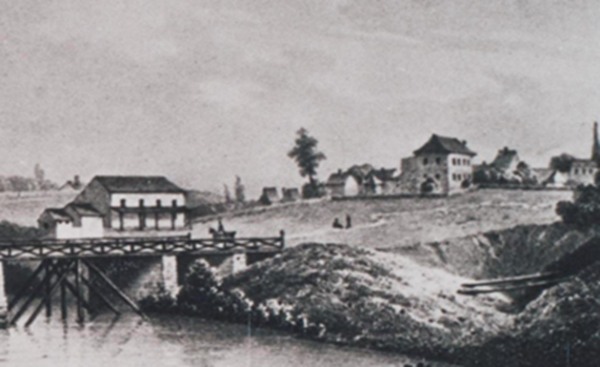
3. Newcastle Gaol and Female Factory · 1831–1846
The female factory occupied part of Newcastle Gaol. With Sydney and Parramatta some distance away, Newcastle could receive and assign women within the Hunter district. Its association with the gaol meant that women in the factory may appear in prison records alongside people held for other reasons. [5], [6]
The archives identify a list of women in Newcastle Gaol awaiting assignment in August 1831 and a list of 40 women ordered to travel from Parramatta to Newcastle aboard the Isabella in October 1832. Those lists can help identify women transferred between factories and narrow the search for the employers to whom they were assigned. [6]
4. Port Macquarie’s first factory · Early 1820s–1828
Port Macquarie opened as a place of secondary punishment in 1821. Small numbers of convict women followed. The first factory was a log-and-plaster building adjoining the gaol, with space for about 50 women. Its construction made the premises difficult to secure. [7]
Women in the penal settlement worked at tasks including cooking, sewing, washing, picking oakum and agricultural labour. The factory also accommodated women who were unwell or nursing babies. Early returns, correspondence and trial papers may name women whose labour or confinement left little trace in surviving buildings. [7], [8]
5. Port Macquarie’s second factory · 1828–1842
A brick factory completed in 1828 replaced the earlier structure. It stood some distance from the original premises. The change is important when interpreting maps of Port Macquarie because a plan of the earlier gaol and factory cannot locate the replacement building. [7]
In the later years, many women went into assigned service. The factory closed in 1842 and the remaining women were ordered back to Parramatta. Monthly assignment returns and records of the factory listed by Museums of History NSW provide a starting point for tracing those movements. [8], [9]
6. Brisbane Town Female Factory, Moreton Bay · c. 1829–1837
Brisbane Town’s factory stood on Queen Street, on the site now occupied by the General Post Office. Moreton Bay was then part of New South Wales. The colonial authorities sent women there for secondary punishment, and work at the factory included washing, needlework and picking oakum. [9], [10]
The Queen Street site was close to the soldiers, prisoners and officials of the settlement. The authorities began moving women to Eagle Farm in the early 1830s and completed the transfer in 1837. Queensland State Archives lists plans for the Brisbane Town factory and Eagle Farm barracks, allowing researchers to compare how the two places were laid out. [10], [11], [12]
7. Eagle Farm Women’s Prison and Factory, Moreton Bay · 1830s–1839
Eagle Farm combined confinement with agricultural labour. Women weeded, dug furrows and harvested crops, as well as doing needlework. Cells, a hospital and a timber palisade formed part of the compound as it developed. The transfer from Brisbane Town took place over several years. [11]
By late 1839, almost all the women had left Eagle Farm. The wider penal settlement closed later. The state and local heritage records recognise the prison and factory site, and the surviving plans document buildings that no longer stand. [11], [12], [13]
8. Bathurst Female Factory · 1833–mid-1840s
Bathurst’s factory began receiving women in 1833. The Bathurst Family History Group identifies the first group as 15 women who had arrived aboard the Fanny. The factory became part of the government establishment serving the growing inland settlement. A later two-storey building had upstairs sleeping accommodation, a kitchen wing and a washhouse. [14]
The factory helped supply labour to households and farms in the district. Researchers can look for women in local gaol records and assignment returns, then follow them into church registers and family records. Bathurst Council’s thematic history dates factory use to 1844, while local family history research records the final break-up in 1846. [6], [14], [15]
Van Diemen’s Land
9. Hobart Town Female Factory · 1820s–1828
Hobart Town’s first factory occupied rooms associated with the gaol at Macquarie and Murray Streets. Its small premises and insecure accommodation made the work of holding, employing and supervising women difficult. Sources date the early establishment differently, so the 1820s is the clearest shorthand for the gaol-based phase. [3], [9]
The gaol setting shaped the women’s experience. Overcrowding, the shortage of suitable work and escapes exposed the limitations of the premises. Some women were sent to George Town after disturbances in 1826. The opening of Cascades in 1828 shifted the main southern operation out of central Hobart. [3], [9], [16]
10. George Town Female Factory · c. 1822–1834
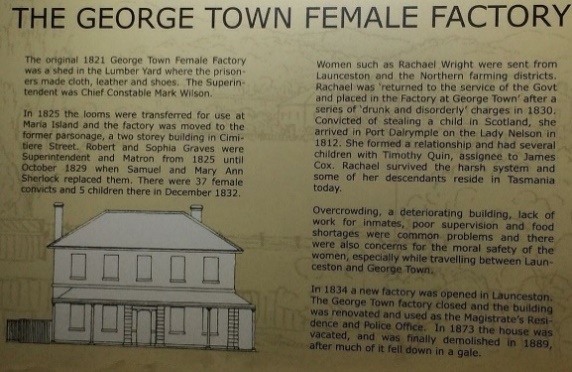
George Town served the north of Van Diemen’s Land from the lower Tamar. The factory moved from the lumber yard into a former residence. Supplies and suitable machinery were limited, and the transfer of textile machinery to Cascades in 1828 left work such as washing, sewing and mending. [3], [9]
As courts and population concentrated around Launceston, transporting women between the two towns became increasingly impractical. Women travelled along the Tamar by road or water. When the purpose-built Launceston factory opened in 1834, the remaining women at George Town were transferred there. [9]
11. Cascades Female Factory, South Hobart · 1828–1856
Cascades became the principal institution for convict women in Van Diemen’s Land. It opened in 1828 on a former distillery site and expanded into a complex of walled yards. It received women for assignment, punishment and care, including mothers with young children. The historic site estimates around 7,000 convict women spent time there. [16], [17]
Cascades is Parramatta’s sister site in the history of female transportation. Comparing the two helps explain how separate colonial administrations organised women’s labour, punishment and maternity care. At South Hobart, surviving walls, archaeology and the Matron’s Quarters help explain how the place worked. Explore the dedicated Cascades page for the yards, women’s lives and research records. [16], [17], [18]
12. Launceston Female Factory · 1834–1855
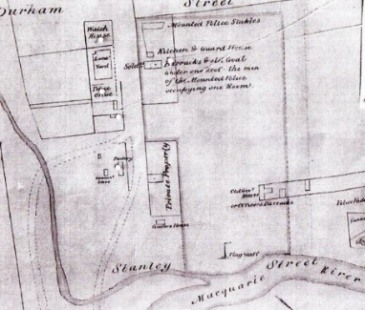
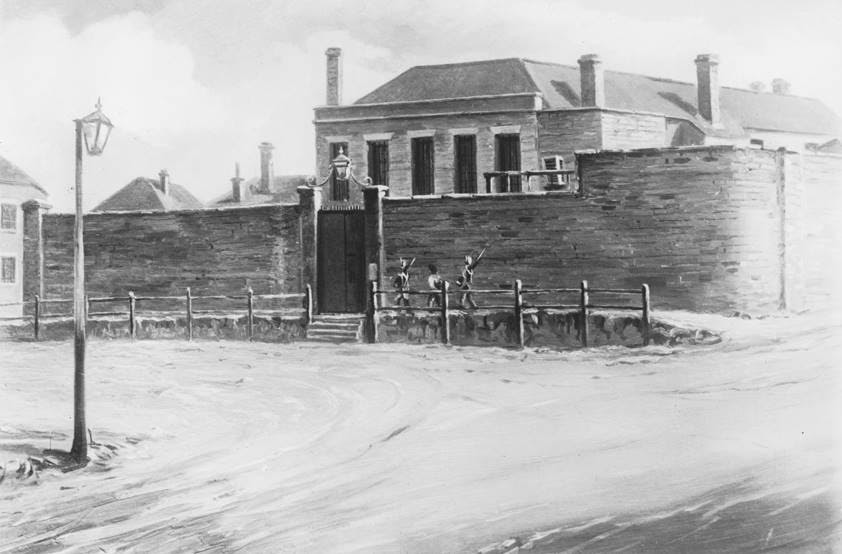
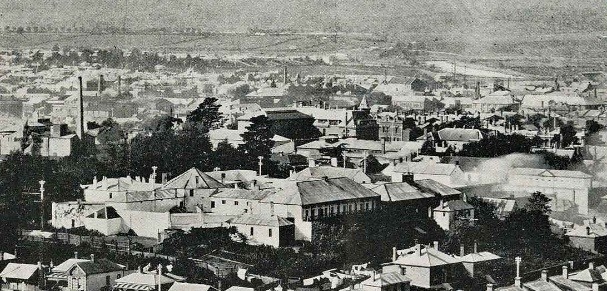
The purpose-built Launceston factory opened in 1834 beside the gaol, in the area now occupied by Launceston College. Colonial architect John Lee Archer designed a cross-shaped building within an octagonal enclosure, with yards that separated women by class. Its opening ended the need to send northern prisoners to George Town. [3], [9]
The design did little to prevent every escape or disturbance. Women were transferred between Launceston and Cascades, so a woman recorded in the north may later appear in southern records. Historical plans, conduct registers and court proceedings can be read together to trace such cases. [9], [19]
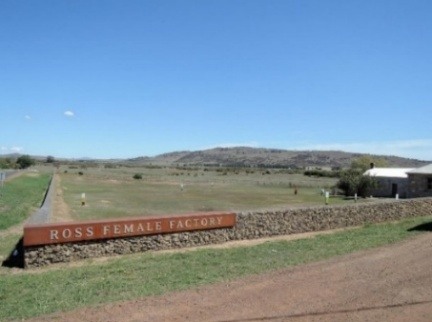
13. Ross Female Factory · 1848–1854
Ross occupied a former male probation station in the Midlands. Its conversion began in 1847 and the female establishment opened in March 1848. It served as a place of confinement and probation, a hiring depot, an overnight stop, and a place for childbirth and nursery care. [9], [20]
Its position between Hobart and Launceston made Ross a point of transfer as well as a place where women stayed. The surviving stone overseer’s cottage and traces of other structures help interpret the former station. Where records say that a woman was sent to Ross, check whether she was in transit, held for punishment, awaiting hiring or staying with a child. [9], [20]
Start with a woman’s name and ship
Record the woman’s name, spelling variants, ship and year of arrival. Then build a dated sequence from indents, assignment records, court proceedings, conduct records, and marriage or baptism registers. Check whether a factory entry records admission, transfer or discharge. One woman can appear several times in the records of one factory, and the same woman can appear in records for more than one institution. [2], [6], [8], [19], [21]
Sources
- State Library of NSW, SL Magazine, Winter 2018, p. 36
- Museums of History NSW, Female Factory, Parramatta
- University of Tasmania, Companion to Tasmanian History, Female Factories
- Parramatta Female Factory Friends, Parramatta Female Factory History Fast Facts
- Women Transported exhibition, Other NSW Factories
- Museums of History NSW, Convicts: gaol records
- Historical Archaeology, The Port Macquarie Settlement, New South Wales, 1821–1847
- Museums of History NSW, Convict penal settlements
- Gay Hendriksen, Carol Liston and Trudy Cowley, Women Transported: Life in Australia’s Convict Female Factories
- State Library of Queensland, Convicts on Queen Street: Early Brisbane Gaols
- Brisbane City Council, Roam the River from Creek to Wharf
- Queensland State Archives, Pre-separation Resource Guide
- Brisbane City Council, Eagle Farm Women’s Prison & Factory Site
- Bathurst Family History Group, Bathurst Female Factory
- Bathurst Regional Council, Thematic History
- Australian Government, Cascades Female Factory
- Cascades Female Factory Historic Site, Convict Women’s Tour
- Lovell Chen, Cascades Female Factory Conservation Management Plan
- Libraries Tasmania, Convict records: What is online?
- Tasmania Parks and Wildlife Service, Ross Female Factory Historic Site
- National Library of Australia, Female convicts research guide