
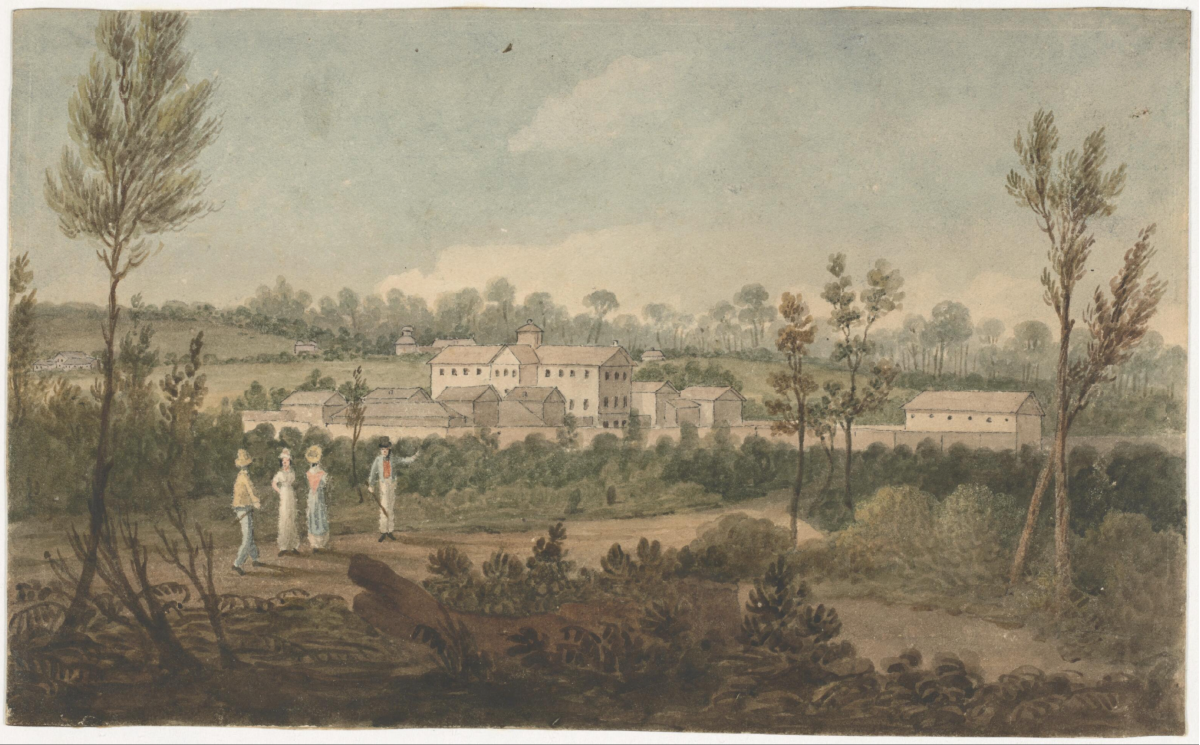
From Dharug Country to Australia’s first purpose-built Female Factory and the later Cumberland Hospital.
The Parramatta Female Factory is one of Australia’s most significant surviving places associated with convict women, colonial institutions and the development of Australian society. Its history spans more than two centuries of colonial occupation and institutional change, but the story of this land began thousands of years earlier.
Dharug Country — Before British Colonisation
Long before European settlement, the land surrounding the Parramatta River was home to the Barramattagal (Burramattagal) people of the Dharug Nation.
The river and its surrounding landscape provided places for fishing, gathering food, camping, resting, ceremony and community life. The riverbanks were rich in fish and eels, while the surrounding woodlands provided animals, plants and materials essential to everyday life.
This was also part of a wider Aboriginal cultural landscape that included meeting and ceremonial places. During the 1790s, Pemulwuy, a prominent Aboriginal resistance leader, led opposition to British expansion in the Parramatta and surrounding districts.
British colonisation brought dispossession, conflict and profound changes to Dharug communities. Despite these disruptions, Dharug people have maintained their cultural connections to Country.
The Parramatta Female Factory and Institutions Precinct stands on this continuing cultural landscape. [1, 2]
Early Colonial Settlement — Smith, Bligh and Marsden
Following the establishment of the British settlement at Parramatta in 1788, land along the river was progressively occupied for agriculture and colonial development.
In 1792, Charles Smith, a former convict who became a farmer, received a 30-acre grant in North Parramatta. He cultivated wheat and maize and raised pigs.
Between 1803 and 1806, the Reverend Samuel Marsden, Anglican chaplain, magistrate and landowner, acquired Smith’s property and subsequently established a watermill nearby.
A separate grant of approximately 105 acres was made to Governor William Bligh, covering much of the land on which the Female Factory would later stand.
These adjoining estates formed part of the early colonial landscape from which the Parramatta Female Factory precinct emerged. [3]
The First Female Factory — 1804–1821
The first Parramatta Female Factory was established around 1804 above the colonial gaol at what is now Prince Alfred Square.
It provided work and limited accommodation for female convicts, particularly women awaiting assignment to employers. Women spun wool and flax, wove cloth and performed other duties for the colony.
Conditions were overcrowded and inadequate.
The Reverend Samuel Marsden became a prominent advocate for establishing a larger institution, although his views on convict women were often severe and reflected the moral attitudes of his time.
Marsden also corresponded with British prison reformers, including Elizabeth Fry, whose work promoted improvements in the treatment, education and welfare of imprisoned women.
Their correspondence helped connect the experiences of female convicts in New South Wales with prison reform movements in Britain. [4, 5]
Governor Macquarie and the New Female Factory — 1818–1821
Recognising the inadequacies of the original Factory, Governor Lachlan Macquarie commissioned a purpose-built institution on the northern bank of the Parramatta River.
The celebrated colonial architect Francis Greenway, himself a former convict, designed the new complex.
The building contract was awarded to William Watkins and Isaac Payten (also recorded as Peyton), with construction undertaken largely through convict labour.
Governor Macquarie laid the foundation stone on 9 July 1818.
The new Parramatta Female Factory opened on 1 February 1821, when women and children were transferred from the overcrowded original establishment.
The sandstone complex included accommodation, workrooms, kitchens, administrative quarters and a hospital, surrounded by substantial walls.
It became Australia’s first purpose-built Female Factory and an important model for subsequent institutions for convict women. [6]
Life Inside the Female Factory — 1821–1848
The Female Factory was much more than a workplace.
It functioned as a labour and assignment depot, a place of secondary punishment, a refuge for unemployed or destitute women, a hospital and a lying-in hospital for childbirth.
Women worked in spinning, weaving, sewing, laundry, domestic service and other occupations. Others were confined for breaches of colonial regulations or offences committed during their sentences.
Many women arrived with children, gave birth within the institution or experienced the separation of their families.
The Factory was progressively divided into classes, distinguishing women awaiting assignment, those performing institutional labour and women subjected to punishment.
As transportation increased, overcrowding, inadequate resources and harsh disciplinary practices contributed to unrest.
Superintendents, Matrons and Reform
The administration of the Factory reflected changing colonial attitudes towards female convicts.
Francis Oakes, Superintendent from 1814 to 1822, oversaw the transition from the original Factory to the new institution. He was followed by William Tuckwell, who served as Superintendent from 1822 to 1824.
Elizabeth Fulloon, later known as Elizabeth Raine, became Matron in 1824.
In October 1827, Ann Gordon was appointed Superintendent and Matron. Her appointment coincided with the first and most widely remembered riot at the Factory.
Later administrators included Sarah Bell and Thomas Bell, who served as Matron and Keeper during much of the period from 1836 to 1843, and Lucy Knight Smyth, who served as Matron during the 1840s.
The Factory’s administration was frequently scrutinised, with continuing debates over discipline, overcrowding, treatment and reform. [7, 8]
Resistance and the Female Factory Riots
On 27 October 1827, women from the Third Class rebelled against conditions and reduced rations. They broke through the Factory gates and entered the streets of Parramatta.
Further disturbances occurred during the 1830s and in 1843.
These actions demonstrate that the women were not simply passive subjects of the convict system. They protested against their treatment, challenged authority and asserted their concerns about food, work and punishment.
The arrival of the Sisters of Charity in 1839 brought another important chapter in the provision of religious instruction, education and support to women within the institution. [9]
Closure and the Beginning of the Asylum — 1847–1850
Following the cessation of convict transportation to New South Wales in 1840, the role of the Female Factory gradually diminished.
The institution ceased operating as a Female Factory at the end of 1847. In April 1848 it became the Convict, Lunatic and Invalid Establishment, accommodating people requiring institutional care.
In 1849, part of the establishment was formally designated for the care and custody of people experiencing mental illness. By 1850 the Parramatta Lunatic Asylum had become established on the site.
The historic Female Factory buildings were progressively adapted for new uses, while additional wards and institutional buildings were constructed.
During the later nineteenth century, some original Factory buildings were demolished, although important sandstone structures, walls and archaeological remains survived. [10]
From Parramatta Lunatic Asylum to Cumberland Hospital
The precinct continued to evolve as one of New South Wales’ major mental health institutions.
Over time, its name changed to reflect successive approaches to psychiatric treatment and institutional care:
- 1850: Parramatta Lunatic Asylum
- 1878: Parramatta Hospital for the Insane
- 1916: Parramatta Mental Hospital
- 1962: Parramatta Psychiatric Centre
- 1983: Cumberland Hospital
Cumberland Hospital has continued to provide mental health services into the twenty-first century.
In 2026, the NSW Government confirmed plans to transfer the hospital’s mental health services to the new Westmead Centre for Mental Health following its planned completion in late 2027.
The transition will mark another significant change in the long institutional history of the precinct. [10, 11]
An Extraordinary Heritage Legacy
Today, the Parramatta Female Factory and Institutions Precinct is recognised as a place of outstanding significance to Australia’s history.
Its surviving buildings, walls and archaeological remains provide rare physical evidence of the experiences of female convicts and generations of people who lived, worked or were confined within the precinct.
The site was placed on the Australian National Heritage List in 2017 and is included on Australia’s UNESCO World Heritage Tentative List.
Parramatta Female Factory Friends continues to research, interpret and advocate for the protection of this remarkable place and the stories of the women, children and communities connected with it.
Discover the Parramatta Female Factory on a Guided Tour
Historical Sources and Endnotes
- City of Parramatta, Dharug and First Nations Community. Background on the Barramattagal people, Country and continuing cultural connections.
https://www.cityofparramatta.nsw.gov.au/community/first-nations/dharug-and-first-nations-community - UNESCO World Heritage Centre, Parramatta Female Factory and Institutions Precinct, Tentative List, 2023. Indigenous cultural landscape, settlement and history of the precinct.
https://whc.unesco.org/en/tentativelists/6686/ - Peter Arfanis, North Parramatta: The First Land Grants, City of Parramatta, 2015. Charles Smith, Governor Bligh and Samuel Marsden’s landholdings.
https://historyandheritage.cityofparramatta.nsw.gov.au/blog/2015/08/05/north-parramatta-the-first-land-grants - City of Parramatta, The First Female Factory, Prince Alfred Square, 1803–1821, 2015. History of the original Female Factory.
https://historyandheritage.cityofparramatta.nsw.gov.au/blog/2015/08/12/the-first-female-factory-prince-alfred-square-1803-1821 - State Library of New South Wales, Letters from Elizabeth Fry, 1820, 1827, Manuscript Collection Af 30. Includes correspondence with Samuel Marsden.
https://archival.sl.nsw.gov.au/Details/archive/110351860 - City of Parramatta, The Second Female Factory: 1818–1848, 2015. Greenway’s design, Macquarie, construction, William Watkins, Isaac Payten and institutional development.
https://historyandheritage.cityofparramatta.nsw.gov.au/blog/2015/07/28/the-second-parramatta-female-factory-1818-1848 - Australian Dictionary of Biography, Francis Oakes (1770–1844). Administration of the original and new Female Factories.
https://adb.anu.edu.au/biography/oakes-francis-2513 - Hilary Weatherburn, Ann Gordon (1795–1868), Australian Dictionary of Biography, 2005. The appointment and administration of Matron Gordon.
https://adb.anu.edu.au/biography/gordon-ann-12943 - Michaela Ann Cameron, Parramatta Female Factory, Female Factory Online. Overview of women’s experiences, the class system, riots and the institution’s operation.
https://femalefactoryonline.org/about/history/parramatta-female-factory/ - City of Parramatta, Parramatta Lunatic Asylum: 1848–1878, 2020. Closure, asylum arrangements and subsequent institutional development.
https://historyandheritage.cityofparramatta.nsw.gov.au/blog/2020/06/04/parramatta-lunatic-asylum - NSW Health, Construction reaches highest point for NSW’s largest mental health facility, 13 August 2026. Planned relocation of Cumberland Hospital services.
https://www.health.nsw.gov.au/news/Pages/20260813_00.aspx - Australian Government, Parramatta Female Factory and Institutions Precinct, National Heritage List. National heritage recognition and surviving historical significance.
https://www.dcceew.gov.au/parks-heritage/heritage/places/national/parramatta-female-factory-and-institutions-precinct
Parramatta Female Factory Friends Inc.
Protecting the past. Researching the women. Sharing the stories.